Thursday, 28 April 2011

Turning Pro Workshops in London and Birmingham

One of the most frequent conversation I have is with photographers who want to go pro

Who have day jobs, or have just left university and want to explore the possibilities of going pro, or perhaps they want to just earn some extra money in their spare time.

The fact is easier to take good pictures than ever before, like any industry photography is driven by supply and demand, and my goodness do we have a lot of supply out there.

Just on the further education front in Britain more photographers are trained than there are jobs for, not just in the UK but in the whole of the EU.

Think of it.

It is against this backdrop that I have decided to run two 'turning pro workshops'

One in London the other in Birmingham.

What's more there will not be a light or camera in sight.

This will be to explore why some brilliant photographers sit at home, and I mean some of the very best photographers in Britain, waiting for the phone to ring, while some less talented individuals work ceaselessly, with full diaries.

There are no hard and fast rules of how to go pro and different photographers have different philosophies.

I will share my philosophy which has kept me competitive and productive in the photographic business for more than 30 years.

I will take you through as many areas as we can cover in one day, promotion, targeting new clients, current clients, why does the other guy the job and not me? Invoicing, shooting stock, should I shoot for free?, what should be in my portfolio, deliverables and I will share the mistakes I have made over the years, so hopefully you won't make them.

This is business based so it will apply to you wether you are a social photographer, wedding photographer, photo journalist or food photographer.

In fact any kind of photographer currently working.

My aim is that delegates will leave with the tools to help them be profitable, professional and happy in their work.

So far the London workshop on the 10th May is pretty much full, though I have a couple of places left, with delegates traveling from as far afield as Denmark and Spain to attend.

I have more spaces available in the Birmingham 12th May workshop though, so if you are interested you can book through my website

Affordable too, at whisker less than £100.00

These are the first ever paying seminars I have done in the UK, yes really!

There will be lighting seminars/workshops from me in the UK this year, along with some much further afield

But I feel very passionately about this much negleted subject.

Come and join me?

Thursday, 21 April 2011

Tim Hetherington and Chris Hondros


I never met Tim Hetherington.

But quite a few of my friends did and were impressed with him in many ways.

When his death  along with Chris Hondros, in the besieged city of Misrata was reported it was dark news indeed.

Not only for his friends family and loved ones who's pain can only be imagined, but also for the wider photographic world.

Stories of his great humanity and bravery have been recounted for much of the day.

Tim was a mover and a shaker who started off in stills and went on to cross over into moving images, even collecting an Oscar nomination along the way.

As Tim said  “If you are interested in mass communication, then you have to stop thinking of yourself as a photographer. We live in a post-photographic world. If you are interested in photography, then you are interested in something — in terms of mass communication — that is past. I am interested in reaching as many people as possible.”

I know nothing of Chris so I feel unable to say anything about him other than like Tim he paid the ultimate price while telling the world what is happening in Mistrata.

A sad day indeed.


Friday, 8 April 2011

Infra red survey

As regular readers of his blog will know, I have been shooting a ton of work on the brilliant if rather pricey Phase One Achromatic back.

I love democracy in Photography so I'm asking readers to suggest other Camera's which work well in IR, wether they be DSLR or compact, I'm seeking your input.

I'm also keen to hear of people's experiences with modified DSLR's

Which is best?

Canon, Nikon, Sony?

Do let me know

It would be great if more people shot IR and not all of us have access to exotic kit.

Friday, 1 April 2011

Raymond Blanc at Le Maison Aux Quat'Saissons


Choosing exactly where to shoot an environmental portrait when you are on assignment is crucial.

Recently I was commissioned to shoot a portrait of one of the most celebrated chefs in the UK, Raymond Blanc, the proprietor of Le Maison Aux Quat'Saissons, two starred Michelin restaurant and hotel

He is an exceptionally nice guy with an eye for detail which is second to none.

Just goes to show that to be a top Chef you don't have to swear, scream and shout......

Now in addition to shooting solo portrait it had to be a location which could accommodate up to 3 people, which complicated things just a little, as it was piercingly bright sunlight and I wanted to get the frontage of his hotel and restaurant in the background.

At times like this my friends head for the shade.

But just where?

There was a portico across the courtyard which should have been the natural choice, but it was an open pillar construction which at first glance seemed to provide little chance of the shade I was looking for, meaning I was going to get shadows and hot spots on the subjects faces no matter what I did.

But then I looked again and saw that if I was very precise and placed the subjects between the two pillars in the centre of the frame there was a tiny sliver of shade which I could locate them in AND still get the iconic building in the background.

Having done the trickiest part it was just a matter of balancing the light with an Elinchrom Quadra diffused with a Chimera Medium softbox (what else?) which I knew would give super softlight on Mr Blanc but also enough coverage for a group of 3 if I had to, this time I used the Avenger A480BU Stacker stands by Manfrotto (I like the super sturdy square legs) and I jammed this combo into the portico, and I thought it would be enough.


I did a test shot to pre light the scene and saw that while it was nice enough, I could in fact do better by adding a backlight coming in from the left hand side of the frame, so bring on a second Quadra and a Chimera small softbox, flagged by one of those pillars. Meaning the backlight would hit the subject and not the front element of my lens.


Illustration by Jarek Wieczorkiewicz


The key light was on full power, as was the backlight.

All set it would seem, but the next challenge was managing a steady stream of cars and delivery vans which wanted to park in shot.

The trick on these occasions is to ask very politely for them to move.

It is always well worth the being extra nice and polite to people at all times, no matter how much stress you are under.

Staying calm, unflustered and polite while under pressure is one of the best bits of self promotion you can do......


The great bonus was that after all the shunting and cars and positioning of lights the frontage of the building came into full sun.


A bit of luck is always welcome.

Friday, 25 March 2011

Infra Red shoot with Ivory Flame and Madame Bink


Readers of this blog will know I LOVE a challenge.

So in the depths of an English Winter I decided to shoot an Infra Red 'Rainforest' type shoot with an 'Eden' vibe

Where to do it?

 I hear Cape Verde is a great location but budget prevailed and I had to come up with an alternative.

So I came up with a green house somewhere in England.

I had the small issue that I wanted it to be a full nude shoot with live snakes.

I asked the location if I could do the shoot and for a fee they agreed.

With the proviso that the glasshouse would be open to the public.

'No problem' I said

At no point did they ask if any nudity or snakes, courtesy of Wrigglies, would be involved.

So operating under the banner of 'don't ask don't tell' it was full steam ahead.

I told the just plain brilliant models Madame Bink and Ivory Flame what they were in for and they did not bat an eyelid, I was more nervous than they were!

With strategic positioning of softboxes and California Sunbounce reflectors, public decency was not offended and nobody rumbled us.

But to say it was a hurried shoot is an understatement.

We lit both of these shots with a Chimera Lantern on a Manfrotto AvengerA4050 lightstand which was which gave the whole scene this great overall look, filling in from the front with a Chimera medium softbox at one stop under the lantern.


I love the A4050 lightstand as it is very flexible, not just very substantial lightstand but a boom too, a must have on any location shoot

Both using Elinchrom Quadra's.

When we had the lighting fixed we just went for it both the portraits and the landscape shots

A very simple set up but it hit the spot.


It was all shot on a Phase One DF camera with the quite amazing Achromatic digital camera back. I used the Razor sharp Schneider LS 110MM lens with a Lee 87 infra red filter.


The video was shot on a Canon XF100 DV camera, which despite its small size is super high quality and has one other feature which was invaluable - it can shoot in infra red too.


The Palms from drew gardner on Vimeo.


All in all a great experience, but nerve wracking all the same.


Wednesday, 23 March 2011

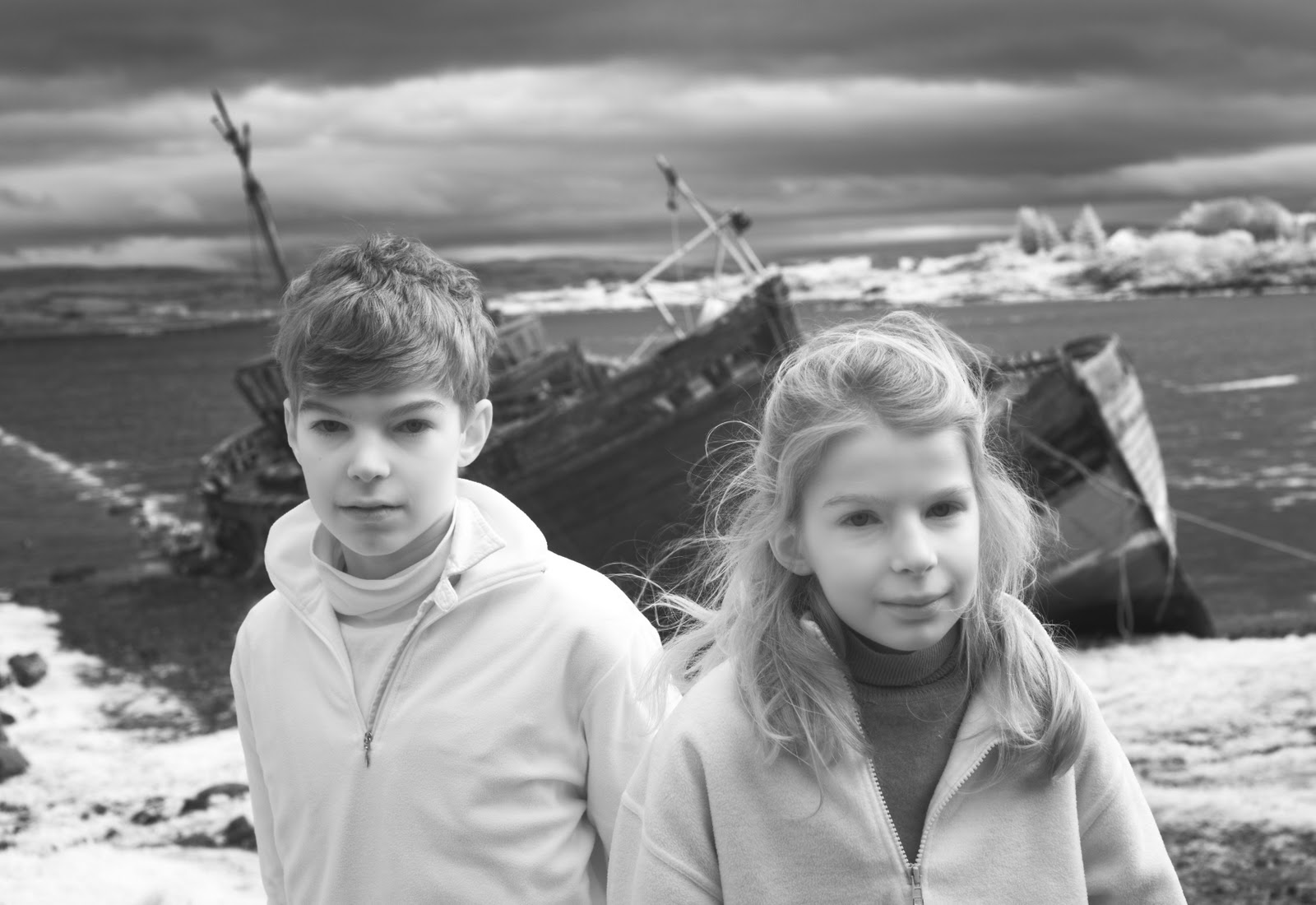
'IT'


I'm always looking for, no searching for 'IT'

'IT' is rather indefinable, it can be found anywhere come in any shape or size, and be just about anything.

For 'IT' is something new (or old) which gives me and my photography the edge, and helps  me to create or reinforce my signature

At the moment 'IT' comes in the form of the unique, exotic and rather pricey Phase One Achromatic+ digital camera back.


The Achromatic back is unique because it shoots in Black and White only

Instead of using a colour sensor, it is the first medium format digital back which uses a black and White sensor.

To quote Phase One

'The Achromatic+ is the first commercially available medium format back that is a true replacement for almost all scientific black and white film types at much higher quality and with far more consistency.
Traditionally, most camera sensors have a Bayer pattern of individual red, green and blue filters for each pixel. These individual colors are then interpolated through numerous methods to create RGB data for each pixel. The Achromatic+ back is designed to be a black and white only product with no color filters on the sensor'

What this means is not only do you get digital black and white quality like never before, but you can shoot in non visible spectrum of light.

Like ultra violet or infra red........

Now this got me excited.

So I decided to try some shots

Not of the traditional black skies and glowing trees (an easy decision to reach in the depths of an English winter) and sweeping landscapes but I thought I would try shooting people.


Some with available light and some with artificial light.

I used a Lee 87 Filter

Which really spiced things up in that I could not see to focus

At all.

Yes, the infra red focusing mark maybe present on some lenses but I found this to be variable in accuracy to say the least.

So tethered shooting it was

Even then it was a pretty 'willow the wisp' to get in focus.

When shooting in the non edible spectrum with things that move, like people and animals, it was a challenge.

But boy what a challenge!

I have not had so much fun taking pictures in a very long time

When digital photography came along so did an immediacy, which meant the 'heart in the mouth' moment of 'has it come out?' was gone forever.

Until now.

You simply never know how things are going to work out when you shoot in infra red.

Fun is back.

But like so many things fun has it's price.


And that price is high, very high.


More than £20,000

Why?

Black and White sensors are made in such small numbers that the price is sky high.

Who knows they may one day have an offering which sells for less? I would not hold my breath though.

Perhaps some of the more switched on rental houses will get them in?
In the meantime there are companies which will convert your DSLR to infra red for much less.

But this is still with colour sensors and infra red only, I hope to be trying a conversion out in the future.


I still think it is worth looking into, though.

 It is an 'edge' in a world of 'me too' predictable photographic results.

Very unpredictable and exciting, and a great way to stand out from the rest of the pack.

Something great to go into a meeting with and impress clients


Friday, 18 March 2011

Focus on Imaging- Show report 2

Like any other stills guys going into moving images I'm sure many of you, as I have, been stopped in their tracks by the big monster we all fear and don't know enough about.

Sound.

To be honest you really are best off working with an experienced sound recorder if you want to get the very best quality on a commercial paying job.

Remember, if the sound is screwed, the whole project can be too.

But what about the rest of the time when you are dealing with it by yourself, for solo or low budget jobs?
Well it is quite a learning curve, I have all sorts of Gizmos like booms, Rode NTG-3 shotgun mic, Sennheiser radio mics and the obligatory Zoom H4N audio recorder, for when I need separate audio.
If you are anything like me you will find yourself struggling to handle stuff mid shoot.
Where to put the Zoom H4N while I'm shooting?

Well when I'm working on a tripod I use the brilliant little magic arm made by Manfrotto, the Mini Hydrostat arm 814 which I attach to the head of my Manfrotto 504HD head and I can monitor sound.

This hydrostatic arm has a ton of uses, like attaching a monitor, but also for more general applications, which I will be blogging about at a later date.

But what about working on the fly, you can mount the Zoom on the hot shoe, but that does leave you open to the inevitable 'handling' noise.
I bumped into the irrepressible Tim Constable from Rycote, who are renowned the world over for their sound recording solutions, such as wind jammers and mic suspension systems.
The portable recorder Audio kit, and their mic works on a patented 'lyre' which really does the job.
Rycote has now made a variant of this system to enable the mounting of the zoom to the hotshoe or via a handle which minimizes handling noise.

Tim bought an early version of it to focus and gave me a quick demo.
I shot and edited a short video on my iPhone. There is a higher res version on Vimeo


I have not yet used it in action, but feel it is very worthwhile of investigation.
If it is something which can make a difference to improve audio quality when you are up against it, I m keen to give it a go.